

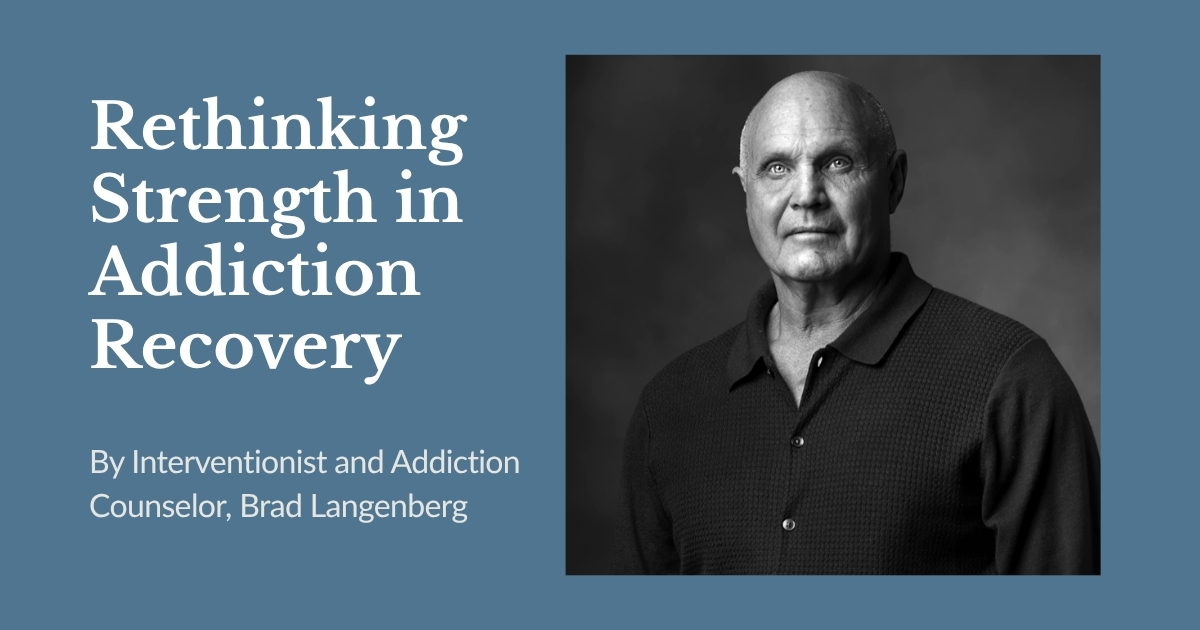
Rethinking Strength in Addiction Recovery
Most people struggling with addiction believe the same thing:
“I just need to be stronger.”
Stronger willpower. More discipline. Better control.
It sounds right, and it’s what we’ve been taught. But in reality, this way of thinking often keeps people stuck in the same cycle. They push harder, fall back, feel shame, and then try again with even more force.
After decades of working in addiction recovery, I’ve seen that real change doesn’t come from trying to be stronger.
It comes from something else entirely.
Recovery begins when a person is able to pause, step back, and start seeing what’s actually happening beneath the surface. Not just the behavior, but the patterns, the emotions, and the automatic reactions driving it.
This is where awareness starts. And where real change becomes possible.
Brad Langenberg was Interviewed by Soft White Underbelly: Watch the Interview
Brad was recently featured on Soft White Underbelly, where he shares his perspective on addiction, recovery, and the role of awareness in lasting change.
The response has been immediate, with thousands of views and hundreds of comments from people who see themselves in his story and message.
“I almost drank last night but I decided not to. So glad I made that choice.”
“I’m 3.5 years sober and still needed to hear this.”
“I have never seen someone be so well-spoken who really gets it and says the things that I so strongly resonate with, things that we don’t acknowledge or discuss enough. Thank you!”
Why “Being Strong” Often Fails
For many people, recovery starts with a promise:
“This time I’m going to do it differently.”
They commit to stopping, set strict rules, and rely on willpower to push through. For a while, it might even work. But when stress builds, emotions surface, or old environments come back into play, the same patterns often return.
This leads to a familiar cycle.
Try harder. Slip. Feel shame. Try again.
Over time, this cycle can be exhausting. Not just physically, but emotionally. People begin to believe something is wrong with them. That they lack discipline. That they aren’t strong enough.
But the issue isn’t a lack of strength.
It’s that willpower alone doesn’t address what’s actually driving the behavior.
Addiction is not just about the substance. It’s about what’s underneath it. The habits, the emotional responses, the learned patterns that happen almost automatically.
When those aren’t understood, no amount of force or control can create lasting change.
So the question becomes:
If strength isn’t the answer, what is?
Creating Space for Awareness
If willpower isn’t enough, the next step is learning how to slow things down.
In early recovery, most people are used to reacting quickly. A feeling comes up, and the response follows almost immediately. There’s very little space between the trigger and the behavior.
That’s where awareness comes in.
Instead of trying to fight the urge or overpower it, the focus shifts to noticing it. Pausing. Observing what’s happening internally without immediately acting on it.
This might sound simple, but it’s not always easy. It takes practice to sit with discomfort without trying to escape it. But that pause is where something important happens.
It creates space.
And in that space, a person begins to see that they are not their thoughts, not their impulses, and not their past patterns. They are someone who can observe those things.
That shift changes everything.
Because once there is awareness, there is also choice.
Instead of reacting automatically, a person can begin to respond differently. Over time, this builds a sense of stability that doesn’t rely on force, but on understanding.
This is the foundation of real change.
The Role of Trauma, Patterns, and Mental Health
Addiction doesn’t exist in isolation.
For many people, it’s connected to deeper patterns that have been developing over time. Trauma, anxiety, ADHD, OCD, and other mental health challenges can all play a role in how someone experiences the world and responds to it.
These patterns often operate below the surface. They shape reactions, influence decisions, and create cycles that feel automatic.
For example, someone might turn to alcohol or substances not just out of habit, but as a way to manage overwhelming thoughts, regulate emotions, or escape internal discomfort they don’t fully understand.
Without addressing these underlying layers, recovery can feel like an uphill battle.
This is why awareness is so important. It allows people to begin recognizing not just what they are doing, but why they are doing it.
With that understanding, the focus shifts from self-blame to self-awareness.
Instead of asking, “What’s wrong with me?”
The question becomes, “What’s happening, and how can I respond differently?”
That shift creates room for compassion, and more importantly, for real, lasting change.
Experiential Healing and Real-World Awareness
Understanding patterns is important, but lasting change often requires more than insight alone.
This is where experiential work becomes powerful.
In many cases, people can talk about their struggles and even understand them intellectually, but still find themselves repeating the same behaviors. That’s because real change happens through lived experience, not just conversation.
Experiential approaches, including equine-assisted therapy, create opportunities for people to become aware of themselves in real time.
Working with horses, for example, removes the ability to rely on words or explanations. Horses respond to presence, energy, and authenticity. They reflect what’s happening internally, often more clearly than people can see on their own.
This creates a different kind of awareness.
Clients begin to notice how they show up. How they react under pressure. How they handle frustration, fear, or uncertainty. And because it’s happening in the moment, they can start to adjust, reconnect, and respond differently.
These experiences help bridge the gap between understanding and action.
They bring awareness out of theory and into real life, where change actually takes place.
From Survival to Connection
In early recovery, the focus is often on stopping a behavior.
Stop drinking. Stop using. Stop the pattern.
And while that’s an important first step, it’s not the full picture.
If recovery stays centered only on what someone is trying to avoid, it can start to feel like constant resistance. Like holding something back instead of moving toward something meaningful.
Real, lasting recovery shifts that focus.
It becomes less about survival and more about connection.
Connection to self.
Connection to others.
Connection to a sense of purpose and stability.
As awareness grows, people begin to experience life differently. They’re not just managing urges. They’re building something new.
A different relationship with their thoughts.
A different way of responding to stress.
A deeper sense of presence in everyday life.
This is where recovery starts to feel less like a struggle and more like a transformation.
Not perfect. Not easy. But real.
And most importantly, sustainable.
The Core Philosophy
At the heart of this work is a simple idea:
You don’t need to be strong. You only need to connect to what is strong.
For many people, strength has been defined as pushing through, holding it together, or forcing change. But that kind of strength doesn’t last. It wears people down.
The kind of strength that supports real recovery is different.
It’s found in awareness.
In presence.
In the ability to pause instead of react.
It can also come from outside of ourselves. From connection to others, to guidance, to something greater than the patterns we’ve been living in.
When someone begins to access that kind of strength, even in small moments, things start to shift.
They don’t have to fight as hard.
They don’t have to control everything.
They can begin to trust the process.
Recovery becomes less about forcing a new life, and more about allowing a different way of living to emerge.
And that’s where real change takes root.
Conclusion: A Different Way Forward
If you’re struggling, or if you love someone who is, it’s easy to believe that things won’t change.
That the patterns are too ingrained.
That the past is too heavy.
That it’s simply too late.
But that isn’t the truth.
Change doesn’t begin with becoming someone new overnight. It begins with a single moment of awareness. A pause. A willingness to see things differently.
From there, something opens.
A new way of responding.
A new sense of possibility.
A different relationship with yourself and the world around you.
Recovery is not about perfection. It’s about waking up to the fact that you are not stuck.
There is another way forward.
And you don’t have to force it.
You just have to be willing to begin.
About the Author
Brad Langenberg is a Certified Addiction Counselor with over 35 years of experience helping individuals and families navigate addiction, mental health challenges, and recovery. His work integrates trauma-informed care, mindfulness, and experiential approaches, including equine-assisted therapy, to support lasting, meaningful change.
Throughout his career, Brad has worked as an interventionist, recovery coach, and counselor, guiding clients toward greater awareness, stability, and connection in their lives.
Watch Brad’s full interview to hear more on this perspective and his approach to recovery.